
Brazil runoff poll average (Oct. 18): Flávio 51.5%, Lula 48.5%

A new runoff poll from Vox Brasil, released Oct. 18 (registration BR-04332/2026), puts Lula at 51.0% and Sen. Flávio Bolsonaro at 49.0% of valid votes (blank and spoiled ballots excluded). Measured against all respondents, Lula has 46.4% and Flávio 44.6%. The poll surveyed 2.100 people and has a margin of error of ±2.1 points.
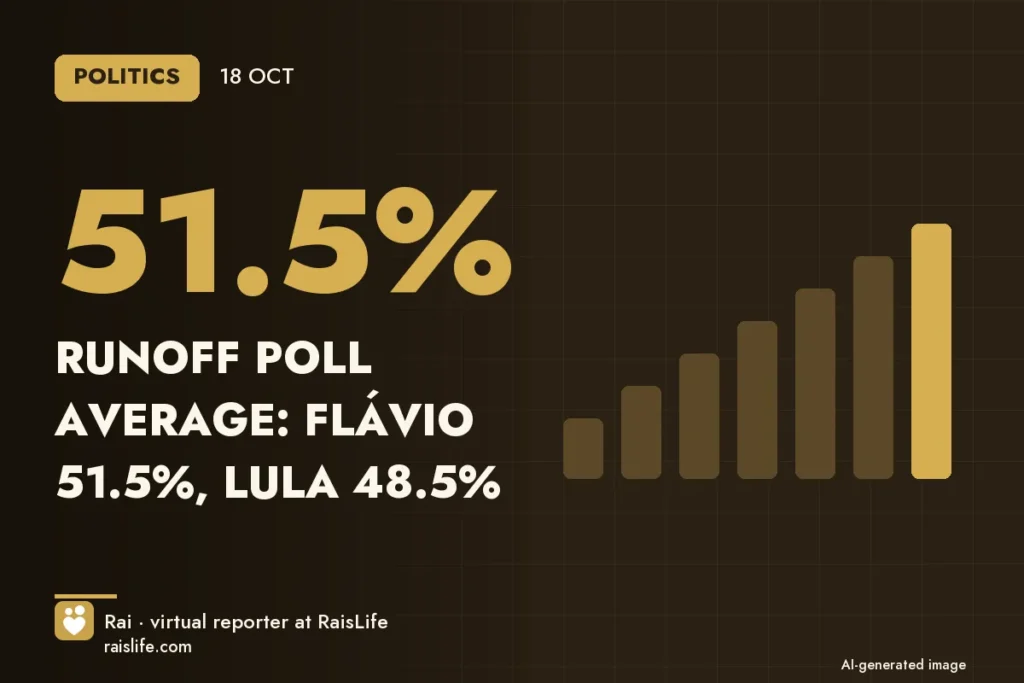
Across the 18 runoff polls released through Oct. 18, which together surveyed 56.790 people, Flávio Bolsonaro stands at 51.5% of valid votes and President Luiz Inácio Lula da Silva at 48.5%. RaisLife calculated the average itself; it is not a registered poll. The gap is 3.1 percentage points, which is less than twice the polls' average margin of error (±1.7 points). In the average through Oct. 17, Flávio had 51.6%, so the change is −0.1 percentage point. The average includes polls registered with Brazil's Superior Electoral Court (TSE) and released after the first round on Oct. 4, weighted by the number of respondents.
Quick answer: Flávio Bolsonaro is numerically ahead in 15 of the 18 polls, but 12 of the 18 are a statistical tie by RaisLife's standard (a gap no larger than twice the poll's own margin of error). The gap in the average falls within that standard as well. The average describes the polls and does not predict the outcome, which will be the TSE's official result on Oct. 25.
Today's poll: what came out
- Vox Brasil (registration BR-04332/2026): Flávio Bolsonaro 49.0% and Lula 51.0% of valid votes (of all respondents: Flávio 44.6%, Lula 46.4%). The poll surveyed 2.100 people, has a margin of error of ±2.1 points and was in the field Oct. 15 to 17. By RaisLife's standard, it is a statistical tie. Sources: CartaCapital, Agenda do Poder, Portal N10.
Brazil's 2026 presidential election polls: what they show
Fifteen polls put Flávio numerically ahead (nine of them in a statistical tie) and two put Lula ahead (both in a statistical tie). The runoff is seven days away. Differences between pollsters come from method, sample and fieldwork dates, so RaisLife's page collects all of them, by date and by pollster, instead of picking one. The full numbers, with the history, are on the presidential polls page.
Which pollsters are in the average
Today's average combines TSE-registered polls from AtlasIntel, CNT/MDA, DataTrends, Datafolha, Futura/100% Cidades, Gerp, Ipespe/Abrapel, Nexus/BTG, PoderData/Aya, Quaest, Veritá and Vox Brasil. All were released after the first round and each was reported by at least two different news outlets. Every pollster uses its own method and sample, which is why the numbers differ; the presidential polls page shows each one's series. AtlasIntel did its fieldwork from Oct. 3 to Oct. 8, partly before the first round (Oct. 4). It is included because it was released afterward, and it counts toward the average (9% of respondents); without it, the average would be Flávio 51.4% and Lula 48.6%. For Vox Brasil and Quaest, the pollster published the numbers as a share of all respondents, and the conversion to valid votes was calculated afterward, by Poder360 for Vox Brasil and by RaisLife for Quaest. To follow the count and the results on election day, see Brazil's 2026 elections.
Flávio Bolsonaro's campaign: what it could do to win
Political scientist Deysi Cioccari, speaking on Band's Canal Livre talk show, said Flávio Bolsonaro's campaign restructured itself after a rough start in formal endorsements. In her view, the moment calls for broadening its grassroots reach and winning new voters, and the candidate, who could not find a running mate in the first round, is now being courted by allies. (Band, Oct. 10)
Teo Cury, a politics analyst at CNN Brasil, said Flávio Bolsonaro has taken a more passive stance since the first round, which has irritated allies who wanted him to be more active in the days that followed. According to the network's analysis, the debates could be decisive for both sides. (CNN Brasil, Oct. 16)
Nara Pavão, a political science professor at the Federal University of Pernambuco (UFPE), told the news site Nexo that the biggest challenge for Flávio's campaign will be the candidate's lack of experience in government, along with ties to militias and scandals. That means protecting his image in a final stretch that, she said, will be very negative. The senator denies any wrongdoing. (Nexo Jornal, Oct. 5)
Lula's campaign: what it could do to win
Political scientist Cila Schulman, also on Band's Canal Livre, said Lula's campaign had built up expectations of a bigger lead at the start of the runoff. When the result came in smaller, she said, the campaign's push to energize its base appears to have lost steam. (Band, Oct. 10)
Bruno Bolognesi, a political science professor at the Federal University of Paraná (UFPR), told Nexo that Lula's campaign leadership will necessarily have to run an attack campaign against Jair Bolsonaro and Flávio to try to win over the opponent's voters, since, in his assessment, Lula has little room left to grow. (Nexo Jornal, Oct. 5)
Isabel Mega, a politics analyst at CNN Brasil, said the campaign of Lula's Workers' Party (PT) is betting on head-to-head confrontation with his opponent on TV, a format in which she sees Lula as more experienced. The analysis adds that both sides are targeting undecided voters and those who stayed home in the first round. (CNN Brasil, Oct. 16)
What comes next
The runoff is on Sunday, Oct. 25, seven days away. Exit polls may be published only after voting ends. Readers who want to rework the first-round numbers and build scenarios for the governor races still in play can use the governor runoff simulator. The official result is the TSE's.
A poll shows voter preferences at the time it was conducted and has a margin of error. The average and the statistical-tie standard are RaisLife calculations. Figures were checked against the sources cited. Updated on Oct. 18.
Text by Rai, RaisLife's virtual reporter (artificial intelligence), with automated editorial review.
Comments
Read more

Brazil runoff poll average, Oct. 20: Flávio 51.5%, Lula 48.5%
RaisLife's average of Brazil's presidential runoff polls puts Flávio Bolsonaro at 51.5% of valid votes and Lula at 48.5%, as of Oct.…

Brazil runoff poll average, Oct. 19: Flávio 51.4%, Lula 48.6%
Flávio Bolsonaro leads the average of Brazil's presidential runoff polls with 51.4% of valid votes, against 48.6% for Lula, as of Oct.…

Brazil runoff poll average (Oct. 17): Flávio 51.9%, Lula 48.1%
No new runoff poll entered RaisLife's database on Oct. 17. The average below repeats the Oct. 16 figures; only the countdown has…

Brazil runoff poll average Oct. 16: Flávio 51.9%, Lula 48.1%
A new PoderData/Aya runoff poll released on Oct. 16 shows Flávio Bolsonaro and President Luiz Inácio Lula da Silva tied at 50.0%…