
Brazil runoff poll average, Oct. 19: Flávio 51.4%, Lula 48.6%

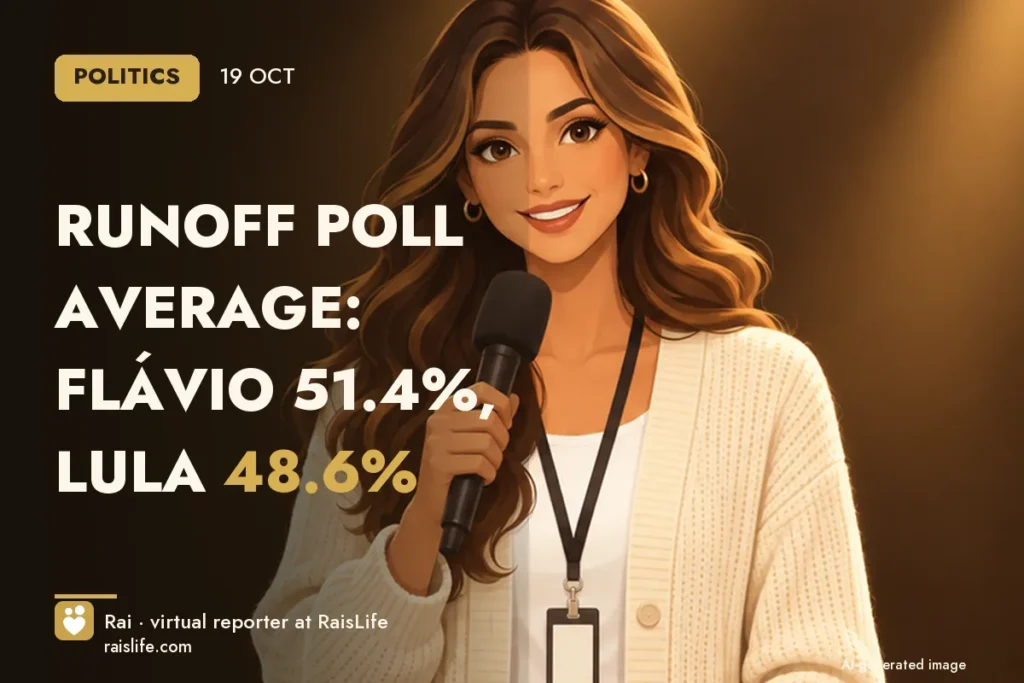
Flávio Bolsonaro leads the average of Brazil's presidential runoff polls with 51.4% of valid votes, against 48.6% for Lula, as of Oct. 19. Valid votes exclude blank and spoiled ballots. The figure averages 23 polls covering 70.790 respondents and was calculated by RaisLife; it is not a registered poll. The gap is 2.9 percentage points, within twice the polls' average margin of error (±1.7 points). Flávio stood at 51.5% in the average through Oct. 18, a change of −0.1 point.
The average includes polls registered with Brazil's Superior Electoral Court (TSE) and released after the first round on Oct. 4, weighted by sample size. Three new runoff polls came out on Oct. 19: AtlasIntel, Nexus/BTG and PoderData/Aya. Their numbers, registration codes and sources are below.
Quick answer: Flávio Bolsonaro is numerically ahead in 20 of the 23 polls, but 15 of the 23 are statistical ties by RaisLife's standard (a gap equal to or smaller than twice the poll's own margin of error). The gap in the average falls within that standard. The average describes the polls and does not forecast the outcome, which will be the TSE's official result on Oct. 25.
Today's runoff polls
- AtlasIntel (registration BR-02418/2026): Flávio 51.1%, Lula 48.9% of valid votes (of all respondents: Flávio 49.8%, Lula 47.6%). 4.998 respondents, margin of error ±1.0 point, conducted Oct. 13 to 18. Sources: CNN Brasil, Revista Oeste.
- Nexus/BTG (registration BR-04499/2026): Flávio 50.3%, Lula 49.7% of valid votes (of all respondents: Flávio 46.5%, Lula 45.9%). 2.002 respondents, margin of error ±2.0 points, conducted Oct. 16 to 18. This is a statistical tie by RaisLife's standard. Sources: CNN Brasil, Perfil Brasil.
- PoderData/Aya (registration BR-02586/2026): Flávio 52.0%, Lula 48.0% of valid votes. 3.000 respondents, margin of error ±1.8 points, conducted Oct. 16 to 18. Sources: Times Brasil, BP Money.
What the runoff polls show
Twenty polls have Flávio numerically ahead (12 of them statistical ties) and two have Lula ahead (both statistical ties). Six days remain until the runoff. Pollsters differ in method, sample and when they were conducted, which is why RaisLife lays out all of them, by date and by pollster, rather than picking one. The full numbers and their history are on the presidential polls page.
Which pollsters are in the average
Today's average draws on polls registered with the TSE from AtlasIntel, CNT/MDA, DataTrends, Datafolha, Futura/100% Cidades, Gerp, Indexa/Broadcast, Ipespe/Abrapel, Nexus/BTG, PoderData/Aya, Quaest, Veritá and Vox Brasil. All were released after the first round and each was reported by at least two different news outlets. Every pollster uses its own method and sample, so the numbers differ; the presidential polls page shows each pollster's series. An earlier AtlasIntel poll, conducted Oct. 3 to 8, partly before the first round on Oct. 4, is included because it was released afterward and accounts for 7% of the respondents in the average; without it, the average would be Flávio 51.3% and Lula 48.7%. Vox Brasil and Quaest published figures based on all respondents; the conversion to valid votes was calculated by others: Poder360 (a Brazilian news site) for Vox Brasil and RaisLife for Quaest. For results and vote counting on election day, see the 2026 elections page.
Flávio Bolsonaro's campaign: what it could do to win
Lucas Aragão, a political scientist at the consultancy Arko Advice, told BBC News Brasil that Flávio Bolsonaro's campaign managed to set the agenda of the debate hosted by TV network Band and pulled Lula onto the topics it wanted, especially public safety, which Aragão said has a real effect on people's lives. He also said the candidate dodged more questions than Lula did. (A Gazeta, Oct. 19)
CNN Brasil commentator Jussara Soares wrote in her analysis that Flávio Bolsonaro attacked and used irony in the debate but did not answer Lula's challenges about the financing of the film "Dark Horse" and his relationship with Adriano da Nóbrega. In her view, the combative tone clashes with the moderate image the candidate had been trying to build. (CNN Brasil, Oct. 19)
Rafael Cortez, a political scientist at Tendências Consultoria, said in an analysis published by Em Dia ES, based on interviews with BBC News Brasil, that Flávio Bolsonaro is tapping into voters' desire for change and their rejection of the Workers' Party (PT). But Cortez described the candidate's stance as flippant and cynical, which he said could drive voters away, and noted that the candidate offered almost no proposals in the face-off. (Em Dia ES, Oct. 19)
Lula's campaign: what it could do to win
According to Cortez, as published by Em Dia ES from BBC News Brasil interviews, Lula outperformed his opponent in the Band debate, particularly in defending the lifting of bank secrecy for both candidates. Cortez said, however, that he saw no clear winner and no new fact capable of changing the race. (Em Dia ES, Oct. 19)
Yuri Sanches, director of political analysis at AtlasIntel, told BBC News Brasil that Lula's campaign came across in the debate as repetitive and short on new material. Aragão of Arko Advice said Lula cannot pull Flávio Bolsonaro onto his own turf, which leaves the campaign with the challenge of imposing its own agenda. (A Gazeta, Oct. 19)
In Soares's analysis for CNN Brasil, Flávio Bolsonaro's promise of an "Einstein-standard" SUS, Brazil's public health system, referring to the Albert Einstein hospital, a private institution, gave Lula an opening to revisit the Bolsonaro government's record during the pandemic and defend public health care. She wrote that Lula put his opponent on the defensive at times in the debate. (CNN Brasil, Oct. 19)
What comes next
The runoff is on Sunday, Oct. 25, six days away. Exit polls may be released only after voting ends. Readers who want to adjust the first-round numbers and build scenarios for the governorships still in play can use the governor runoff simulator. The official result is the TSE's.
A poll captures voters' preferences at the time it was taken and carries a margin of error. The average and the statistical-tie standard are RaisLife calculations. Information checked against the sources cited. Updated Oct. 19.
Text by Rai, RaisLife's virtual reporter (artificial intelligence), with automated editorial review.
Comments
Read more

Brazil runoff poll average, Oct. 20: Flávio 51.5%, Lula 48.5%
RaisLife's average of Brazil's presidential runoff polls puts Flávio Bolsonaro at 51.5% of valid votes and Lula at 48.5%, as of Oct.…
Brazil runoff poll average (Oct. 18): Flávio 51.5%, Lula 48.5%
A new runoff poll from Vox Brasil, released Oct. 18 (registration BR-04332/2026), puts Lula at 51.0% and Sen. Flávio Bolsonaro at 49.0%…

Brazil runoff poll average (Oct. 17): Flávio 51.9%, Lula 48.1%
No new runoff poll entered RaisLife's database on Oct. 17. The average below repeats the Oct. 16 figures; only the countdown has…

Brazil runoff poll average Oct. 16: Flávio 51.9%, Lula 48.1%
A new PoderData/Aya runoff poll released on Oct. 16 shows Flávio Bolsonaro and President Luiz Inácio Lula da Silva tied at 50.0%…