

Hebrew Prayers for Peace: What They Mean

Near the end of the description under Shelter of Peace, the longest piece on the Hill Radiance channel, there is a note many listeners skip. The channel says the Hebrew words were written for this composition, and that the song is not presented as a traditional Hebrew prayer, a Psalm or a historical liturgical text.
That honesty matters. Hearing "shalom aleinu" over a soft piano, it is easy to picture a centuries-old prayer. It isn't one. Yet the words were not chosen at random either. They come from a vocabulary the Hebrew Bible has long used for peace, rest and the nearness of God.
So what do these Hebrew prayers for peace actually say, and where do their images come from?
Quick answer: the Hill Radiance peace prayers are original lyrics, written in Hebrew for the channel's music. They revolve around "shalom", a word whose root points to wholeness, and echo images such as the still waters of Psalm 23 and the quietness of Isaiah 32:17.
Which peace prayers does the channel sing?
Five videos share the theme: three full-length pieces and two Shorts.
- Shelter of Peace: the main piece, with an intimate male voice, piano, strings and slow ambient textures.
- Peace Within: a short clip built on "shalom aleinu, shalom betochi".
- He Is Near: a short clip on "gam ba-dmama atah karov", which the channel translates as "even in the silence, You are near".
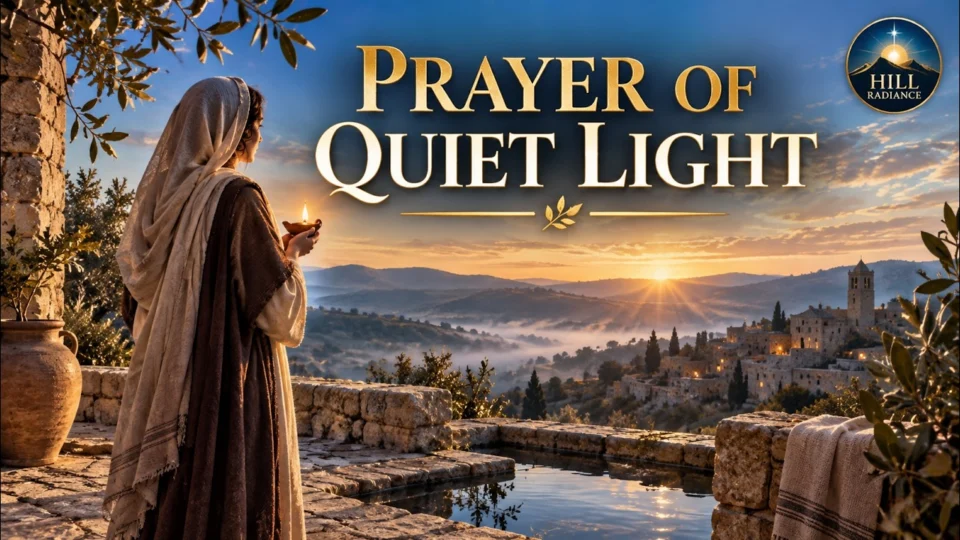
- Still Waters of Peace and Prayer of Quiet Light: two meditative chants whose descriptions give nearly the same English meaning of the lyrics.
Both Shorts point listeners back to the full Shelter of Peace.
What does "shalom" mean in the Hebrew Bible?
"Peace" is the usual translation, but it is a narrow one. Writing for My Jewish Learning, the philosopher Aviezer Ravitzky notes that shalom (שָׁלוֹם) derives from a root denoting wholeness or completeness, and that Jewish literature ties it to shelemut, perfection.
The word closes the priestly blessing in the Torah: "The LORD lift up His countenance upon thee, and give thee peace" (Numbers 6:26), in Hebrew veyasem lecha shalom.
When the channel sings "shalom aleinu, shalom betochi", rendered as "peace around us, and peace within", it reaches for both sides of that wholeness.

Where do the "still waters" come from?
The title Still Waters of Peace recalls Psalm 23:2, al mei menuchot yenahaleni:
"He maketh me to lie down in green pastures; He leadeth me beside the still waters." (Psalm 23:2)
Menuchot belongs to the same family as menuchah, rest. Read closely, the still waters are waters of rest. The song's lyrics, as the channel translates them, do not quote the psalm; they speak of quiet light upon the heart and a spirit of peace. The title builds the bridge, and the lyrics take their own path.

Peace and quietness in Isaiah 32:17
Isaiah joins peace and stillness in a single line:
"And the work of righteousness shall be peace; and the effect of righteousness quietness and confidence for ever." (Isaiah 32:17)
"Quietness" here is hashket (הַשְׁקֵט), from a root meaning to be still. The same root sits in a line of Shelter of Peace, "beyadecha ani shaket", which the channel describes as a posture of stillness in His hands. It is not a quotation of Isaiah, but the words are related.
Psalm 4 pairs peace and rest too: "In peace will I both lay me down and sleep" (Psalm 4:9 in Hebrew numbering, 4:8 in many English Bibles).
"He is near": the idea behind the refrain
The refrain "Adonai, karov elai" centers, in the channel's words, on the nearness of the Lord. Karov, near, is the word of Psalm 145:18: "The LORD is nigh unto all them that call upon Him, to all that call upon Him in truth." Again, the lyrics borrow the word and the idea, not the verse.

How does Hill Radiance perform them?
Shelter of Peace moves slowly, leaving space between phrases, with a close male vocal over piano and warm strings. Prayer of Quiet Light and Still Waters of Peace are chants built on gentle repetition. Their two descriptions share almost the same lyric meaning, opening with "quiet light upon my heart" and ending with "peace upon me, light upon me": two recordings, two moods, one devotional text.
Many people play these tracks during prayer, reading or a quiet evening, which is how the channel itself suggests listening to them.
Conclusion: new words, ancient vocabulary
That small note under Shelter of Peace sums up all five songs. They are not traditional prayers and do not pretend to be. They take words with a long biblical history, like shalom, karov and shaket, and build a present-day prayer from them. Knowing this, you can enjoy the music for what it is, and perhaps open Psalm 23, Psalm 145 or Isaiah 32 to see where the images began.
Frequently asked questions
Are these traditional Jewish prayers?
No. The channel states the lyrics are original, inspired by Hebrew devotional language.
What does "shalom aleinu" mean?
"Peace upon us". The song continues with "shalom betochi", peace within me.
Where is the "still waters" verse?
Psalm 23, verse 2.
References
- Mechon Mamre. Psalm 23 (Hebrew-English, JPS 1917). mechon-mamre.org
- Mechon Mamre. Isaiah 32. mechon-mamre.org
- Mechon Mamre. Psalm 4. mechon-mamre.org
- Mechon Mamre. Psalm 145. mechon-mamre.org
- Mechon Mamre. Numbers 6. mechon-mamre.org
- Ravitzky, Aviezer. Shalom: Peace in Hebrew. My Jewish Learning. myjewishlearning.com
- Hill Radiance. Shelter of Peace (video description). youtube.com
Explore more music and articles in the Hill Radiance section.
Cultural and musical content. Not a substitute for medical or psychological care. Information checked against the sources cited · Last reviewed: October 2026.
Comentários
Mais vídeos
Hebrew Prayers of Mercy and Shelter
In the book of Exodus, Moses climbs Mount Sinai a second time, carrying two new stone tablets after the golden calf. There,…
Orações hebraicas de misericórdia e abrigo
No livro do Êxodo há uma cena que a tradição judaica nunca deixou de repetir. Depois do episódio do bezerro de ouro,…
Orações de paz em hebraico: o que significam
Na descrição de Shelter of Peace, a peça mais longa do canal Hill Radiance, há um aviso que pouca gente lê até…

Psalm 121 in Hebrew: Text, Meaning and Origin
In the ancient Temple in Jerusalem, a flight of fifteen steps led from the Women's Courtyard up to the Courtyard of Israel.…