
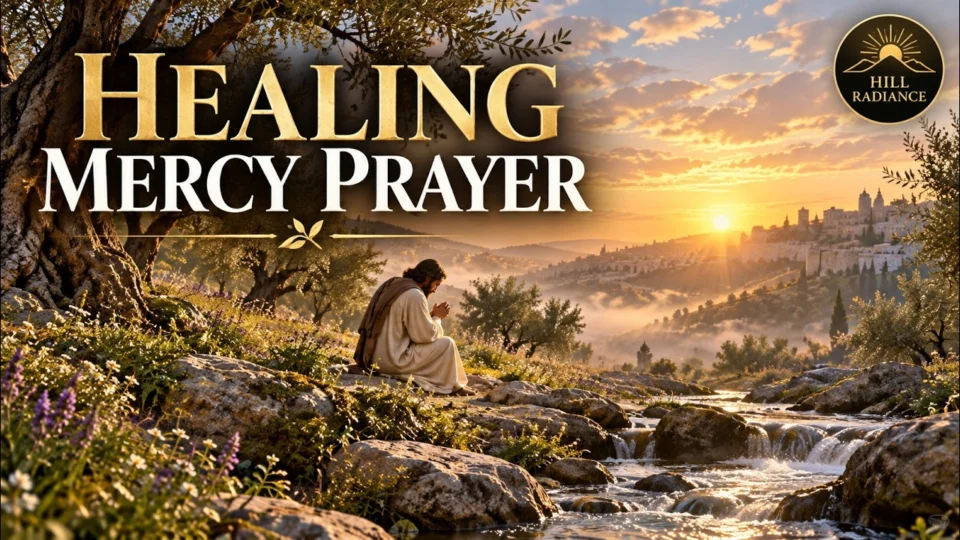
Hebrew Prayers of Mercy and Shelter

In the book of Exodus, Moses climbs Mount Sinai a second time, carrying two new stone tablets after the golden calf. There, the text says, God passes before him and is proclaimed with a list of qualities. The first are rachum and chanun, compassionate and gracious, followed by rav chesed, abounding in kindness (Exodus 34:6).
That sentence never left Jewish prayer. It is repeated again and again in the Selichot, the penitential prayers, and in many communities on festivals when the Torah is taken from the ark. Two songs from the Hill Radiance channel, Healing Mercy Prayer and Prayer of Divine Shelter, draw on that language of mercy and on another old theme: shelter. Where do those words come from?
Quick answer: Healing Mercy Prayer and Prayer of Divine Shelter are original songs by Hill Radiance, sung in Hebrew. They are not part of the Jewish liturgy, but they use biblical images of mercy (rachamim, chesed) and refuge (machseh, the "sukkah of peace") found in the Psalms and the prayer book.
What do rachamim and chesed mean?
Both are often translated as "mercy," but they differ. Rachamim belongs to the same family as rachum, the "compassionate" of Exodus 34:6: the compassion of someone moved by another's pain. Chesed is faithful kindness, love that keeps going. The next verse speaks of "extending kindness to the thousandth generation" (Exodus 34:7).
Jewish tradition calls this passage the Thirteen Attributes of Mercy. They are the core of the Selichot, repeated again and again through those prayers, and the law says they are recited by a congregation of at least ten (a minyan), not by one person alone.
Why "Healing" in the title?
"Healing" names the theme of the prayer, not a promised result. Asking for healing is an old gesture of prayer; the lyrics say "heal my soul, heal my heart," in the sense of comfort and hope after a hard season. Nothing here claims, and the channel cannot guarantee, any effect on the body or health of a listener.
The channel's own English rendering of the lyrics includes "heal me, El Shaddai" (Shaddai is one of the names of God in the Hebrew Bible, used for example in Psalm 91) and images of water and dew: "living waters," "dew of mercy falls upon my face," "every tear becomes dew." Dew has a biblical root too: "I will be to Israel like dew; he shall blossom like the lily" (Hosea 14:6).
The song comes in more than one version. Mercy Dawn leans toward morning; Living Waters leans on the water image.

What is machseh, the refuge of the Psalms?
Machseh means refuge or shelter, a place to hide from danger or a storm. Psalm 91 opens: "O you who dwell in the shelter of the Most High and abide in the protection of Shaddai, I say of God, my refuge and stronghold" (Psalm 91:1–2). "My refuge" is machsi.
Psalm 121 uses the verb "to guard" (shamar): God is "your protection at your right hand" and "will guard your going and coming now and forever" (Psalm 121:5, 8). Shadow, hand and road all return in the Hill Radiance lyrics.
Hashkiveinu: the "sukkah of your peace"
In the liturgy, the prayer closest to this theme is Hashkiveinu ("lay us down"), one of the blessings around the Shema in the evening service, on weekdays and on Shabbat. It asks God to let us lie down in peace and then says ufros aleinu sukkat shlomecha, "spread over us the shelter of your peace."
A sukkah is the fragile booth of the Sukkot festival, roofed with branches so the sky shows through. The shelter asked for is not a fortress but a simple covering. In the Ashkenazi weekday prayer book, the blessing ends: "Blessed are You, Lord, who guards His people Israel forever."
How does Hill Radiance sing shelter?
Prayer of Divine Shelter is also an original composition. The channel's translation has the repeated "guard me, guard me," the line "in the shadow of Your hand, Most High," and a verse close to Psalm 121: "by night and also by morning, You are with me on every road; Your light goes before me, Your peace remains behind me."
Hidden Shelter is the quieter, inward version.

Sacred Covering gives the same text a more solemn tone.
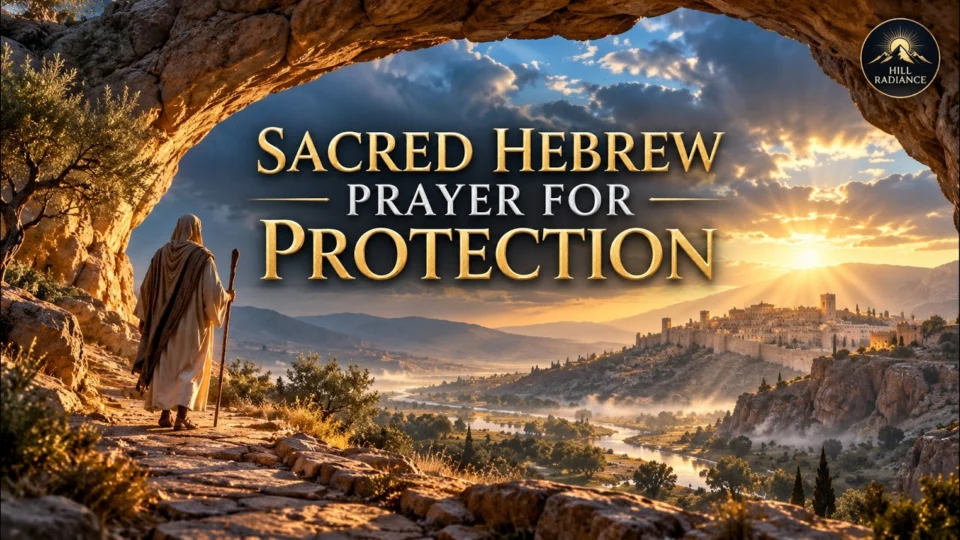
The singing is slow and repetitive, and many people play these tracks during prayer or quiet time at the end of the day. Listeners who know the liturgy will hear echoes of the Psalms and of Hashkiveinu.
Conclusion: old words, a new voice
At Sinai, the list began with compassion and kindness. In the evening prayer, the request is for a booth of peace. These songs are not liturgy and do not replace the tradition they borrow from. They take the vocabulary of rachamim, chesed and machseh and sing it in a new way, for anyone who wants to listen closely to what those words have said for so long.
Frequently asked questions
Are these songs part of the Jewish liturgy?
No. They are original compositions by Hill Radiance, inspired by biblical texts and the language of prayer.
Where does "sukkah of your peace" come from?
From Hashkiveinu, recited in the evening service after the Shema, on weekdays and Shabbat.
What does El Shaddai mean?
It is one of the names of God in the Hebrew Bible, traditionally rendered "God Almighty." The full form appears in Genesis 17:1; the short form, Shaddai, is in the first verse of Psalm 91.
References
- Exodus 34:6-7. sefaria.org
- Genesis 17:1. sefaria.org
- Psalm 91:1–2. sefaria.org
- Psalm 121:5–8. sefaria.org
- Hosea 14:6. sefaria.org
- Siddur Ashkenaz, Weekday Maariv, Hashkiveinu. sefaria.org
- My Jewish Learning, Hashkiveinu. myjewishlearning.com
- My Jewish Learning, The 13 Attributes of Mercy. myjewishlearning.com
- Shulchan Arukh, Orach Chayim 565:5 (the Thirteen Attributes and the minyan). sefaria.org
- Hill Radiance channel. youtube.com/@HillRadiance
More songs and articles in the Hill Radiance section.
Cultural and musical content. It does not replace medical or psychological care. Information checked against the sources cited · Last reviewed: October 2026.
Comentários
Mais vídeos
Orações hebraicas de misericórdia e abrigo
No livro do Êxodo há uma cena que a tradição judaica nunca deixou de repetir. Depois do episódio do bezerro de ouro,…
Hebrew Prayers for Peace: What They Mean
Near the end of the description under Shelter of Peace, the longest piece on the Hill Radiance channel, there is a note…
Orações de paz em hebraico: o que significam
Na descrição de Shelter of Peace, a peça mais longa do canal Hill Radiance, há um aviso que pouca gente lê até…

Psalm 121 in Hebrew: Text, Meaning and Origin
In the ancient Temple in Jerusalem, a flight of fifteen steps led from the Women's Courtyard up to the Courtyard of Israel.…