



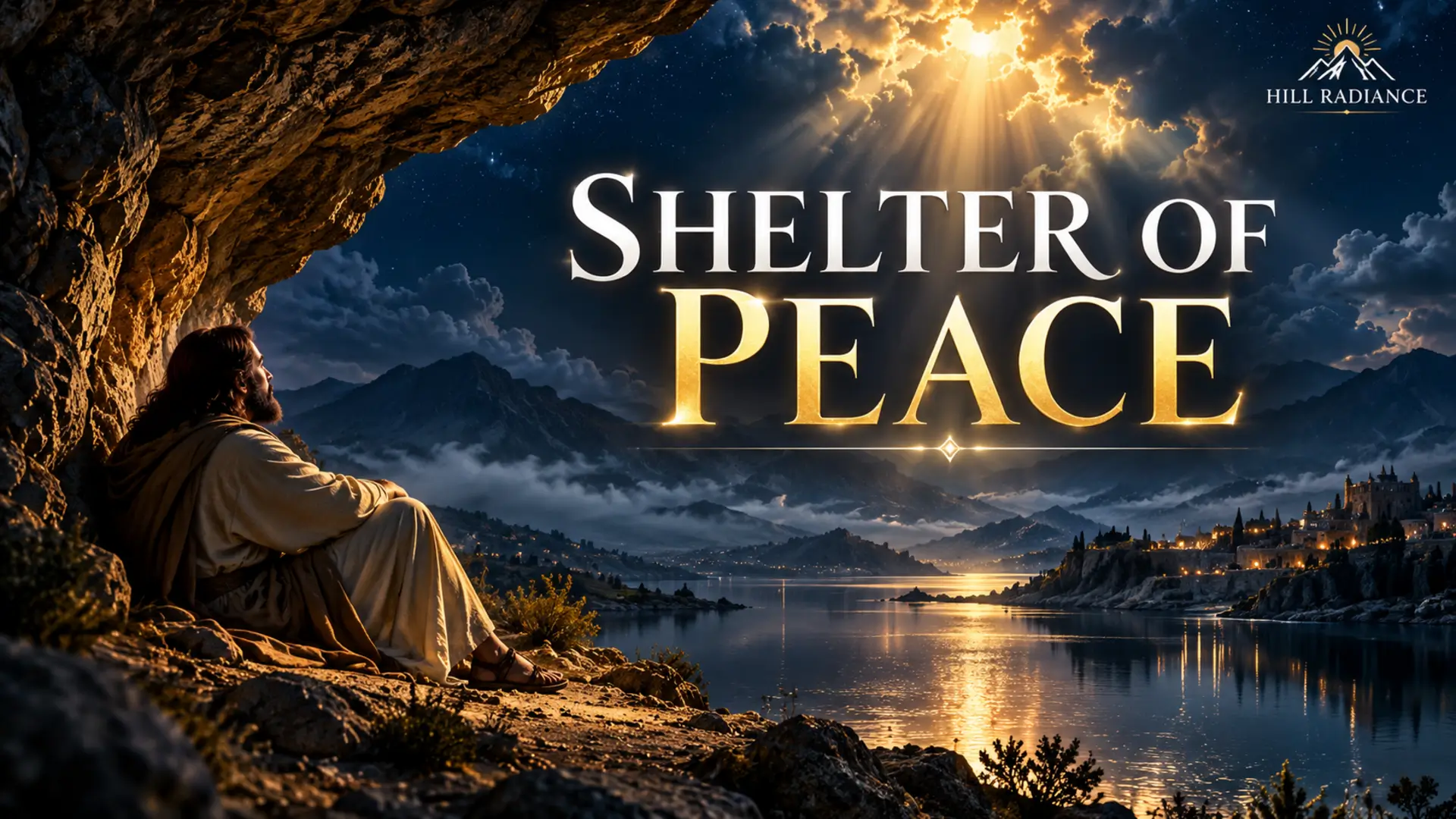





A quiet original Hebrew devotional prayer for stillness, shalom, spiritual rest, and the remembrance that God is near.
There are moments when the soul does not need another explanation. It does not need more information, a louder answer, or a faster solution. It needs stillness. Shelter of Peace was created for that kind of moment: a long, contemplative Hebrew devotional experience centered on peace, trust, rest, light, and divine nearness.
Shelter of Peace is an original devotional composition from Hill Radiance. It is not a traditional Hebrew prayer, not a Psalm set directly to music, and not a historical liturgical text. Its words were written as a contemporary sacred prayer using Hebrew devotional language and themes that belong naturally to a life of prayer: asking for peace, remembering that God is near, resting in His hands, and seeking light for the path ahead.
The music unfolds slowly because peace often does. There is no need to rush through this experience. The gentle piano, warm strings, deep ambient tones, and distant choral textures are designed to leave space between phrases. The pauses matter. The repetition matters. The long duration matters. Together, they create room for the listener to stop striving for a moment and simply remain present.
A prayer built around stillness
Many songs are designed to move quickly toward a chorus, a climax, or a memorable hook. Shelter of Peace follows another path. Its structure is devotional rather than commercial. The recurring lines return like a prayer repeated quietly until the words begin to settle deeper than thought.
One of the central phrases is:
“Shalom aleinu, shalom betochi.”
The prayer turns toward peace both around us and within us. Shalom is richer than the absence of conflict. In a devotional context, it can evoke wholeness, quiet, completeness, and a sense that what is fragmented can be gathered again before God.
That is why the music does not treat peace as a dramatic victory. It approaches peace as a place of rest.
The listener is not pushed toward a peak. Instead, the arrangement keeps opening small spaces for breathing, reflection, and return. This is especially important in long-form prayer music, where the purpose is often not to entertain every second, but to create an atmosphere that can remain with someone during prayer, reading, journaling, evening rest, or quiet time.
The meaning of shelter in this composition
The title Shelter of Peace is not meant to describe a physical place alone. It expresses an inner spiritual movement: leaving noise and urgency for a place of trust.
A shelter can be a room, a landscape, a moment of silence, or a posture of the heart. In this prayer, shelter is connected to nearness.
“Adonai, karov elai.”
The line returns to the idea that the Lord is near. The composition does not try to explain every difficulty or remove every unanswered question. Instead, it keeps returning to presence.
That distinction matters. Prayer does not always resolve uncertainty immediately. Sometimes prayer gives us a place to stand while uncertainty remains.
Shelter of Peace was written around that experience. The words move from fear toward calm, from mental noise toward stillness, and from the need to control everything toward a quieter trust.
Hebrew in the soul of the prayer
Hill Radiance is built around a simple creative principle: Hebrew in the soul, English in the packaging.
The public titles and descriptions are written in English so that listeners around the world can discover the music easily. But the spiritual identity of the songs remains connected to Hebrew prayer language, Psalms, Tehillim, sacred imagery, and contemplative devotional expression.
In Shelter of Peace, the sung text uses Hebrew transliteration. That allows the sound of the language itself to remain part of the experience.
The goal is not to imitate a traditional prayer or claim historical authority. It is to create an original devotional composition whose language, musical pacing, and atmosphere feel connected to the sacred world that inspires Hill Radiance.
This distinction is important. A listener should always know whether a piece is a traditional prayer, a direct Psalm setting, a composition inspired by Scripture, or an original devotional work. Shelter of Peace belongs to the last category: it is an original prayer.
Selected phrases from Shelter of Peace
Several recurring lines carry the emotional center of the song.
“Adonai, karov elai.”
This line centers the prayer on divine nearness. Rather than beginning with a request for circumstances to change, it begins with relationship and presence.
“Shalom aleinu, shalom betochi.”
The prayer widens from inner peace to shared peace. It asks for shalom not only as a private feeling, but as something that can surround and inhabit us.
“Beyadecha ani shaket. Beyadecha ani nach.”
These lines express stillness and rest in God’s hands. They belong to the surrender movement of the composition: the recognition that not everything has to be held tightly by us.
“Orcha al darki.”
The image is simple: light on the path. Not necessarily light on every mile ahead, but enough light to continue walking.
“Adonai, ten li shalom.”
The prayer becomes direct again: Lord, give me peace.
These phrases are intentionally simple. A contemplative prayer does not always need complex language. Repetition can allow a short phrase to become something we stay with rather than something we merely understand once and move past.
When fear becomes quieter
One part of the prayer speaks about fear falling away as the awareness of God’s nearness returns.
This does not mean the music promises that fear will disappear instantly or that listening to a song guarantees emotional or spiritual change. Shelter of Peace is not presented as a treatment or supernatural guarantee.
Instead, the song offers a devotional environment in which the listener can slow down.
That may be especially meaningful during moments when thoughts are racing, the day has been heavy, or silence feels difficult. A long-form prayer can provide a gentle structure for stillness: a voice to follow, a phrase to repeat, a rhythm that does not demand urgency.
Sometimes the first step toward peace is not solving everything. It is becoming quiet enough to notice what we are carrying.
Rest in His hands
Another central movement in the composition is surrender.
“Beyadecha ani nach.”
In Your hands, I rest.
For many people, rest is difficult because the mind continues working long after the body has stopped. We replay conversations, anticipate problems, review unfinished tasks, and try to hold tomorrow before it arrives.
A prayer of surrender creates another possibility.
It does not require pretending that responsibilities do not exist. It is simply an act of remembering that we are not the only ones holding the world together.
That is one reason Shelter of Peace can work well as evening prayer music. The slow arrangement, repeated lines, and restrained dynamics are suitable for the transition from activity into rest.
You can listen actively, following the lyrics, or allow the music to remain softly in the background.
Light for the next step
“Orcha al darki.”
Your light on my path.
This image gives the prayer movement without breaking its stillness. Rest does not mean permanent immobility. Peace can also prepare us to continue.
There are seasons when we want the entire path revealed. We want certainty about the future, clarity about every decision, and reassurance about every outcome.
But often we receive enough light for the next step.
The prayer does not insist on seeing everything. It asks for light while walking.
That makes this part of Shelter of Peace especially fitting for morning reflection, journaling, or moments of decision. It is a reminder that guidance and peace can belong together.
How to listen to Shelter of Peace
There is no single correct way to use devotional music. The same composition may serve different moments on different days.
You may listen during quiet morning prayer before the demands of the day begin.
You may use it during evening reflection when you want to let the pace of the day soften.
It can accompany reading, journaling, meditation, or silent prayer.
Some listeners may prefer to focus on one short phrase at a time. Others may simply let the Hebrew vocals and ambient textures create a peaceful background.
For rest before sleep, the long format allows the music to continue without requiring constant attention.
For prayer, you might choose one phrase and repeat it quietly:
Shalom.
Karov elai.
Beyadecha ani nach.
Orcha al darki.
The purpose is not performance. It is presence.
Why the music is longer than a typical song
Shelter of Peace runs for more than ten minutes by design.
Short songs can be beautiful, but contemplative listening often benefits from time. A longer form gives the music space to repeat without feeling rushed and allows instrumental sections to create breathing room between sung passages.
This is also why the arrangement avoids heavy percussion, dramatic transitions, and a large cinematic climax.
The sound remains restrained.
The voice stays intimate.
The instrumental palette evolves gradually.
The repetition is not meant to create excitement. It is meant to create continuity.
For listeners who use sacred music for prayer, meditation, spiritual rest, or sleep, that continuity can be more useful than constant musical change.
An original devotional composition
Because Hebrew sacred music can include ancient prayers, direct biblical texts, modern compositions, and adaptations, clarity about origin matters.
Shelter of Peace is an original Hill Radiance devotional prayer.
It should not be understood as a direct translation of a Psalm or as a traditional Jewish liturgical prayer. Its words were composed specifically for this musical experience.
The piece draws on devotional themes that are deeply familiar across Scripture and prayer: peace, nearness, trust, light, rest, and the desire to walk with God.
This allows the music to remain rooted in sacred language without making a false claim about textual origin.
Creating a quiet ritual
One of the most meaningful ways to listen to prayer music is to connect it to a simple ritual.
You might dim the lights, put your phone aside, and listen with headphones for ten minutes.
You might play the prayer at the end of the day while writing down what you are ready to release.
You might begin the morning by listening to one section before opening email or social media.
You might sit in silence after the final notes and allow one phrase to remain.
A ritual does not need to be complicated to be meaningful.
Consistency can transform a small practice into a place of return.
Shelter of Peace was created to support that kind of return.
Continue the Hill Radiance experience
Hill Radiance creates sacred Hebrew prayer music, Psalms and Tehillim-inspired works, original devotional compositions, and long-form spiritual ambience for prayer, peace, reflection, rest, and meditation.
If Shelter of Peace resonates with you, continue with the related collection:
Sacred Hebrew Prayers for Peace, Healing and Protection
You can also explore:
Long Hebrew Prayer Music for Sleep, Rest and Deep Meditation
The goal of the channel is not simply to create background music. It is to build a growing library of sacred listening experiences that can accompany real moments of prayer and stillness.
A final word: shalom
Shelter of Peace returns again and again to a simple word: shalom.
Peace within.
Peace around us.
Peace in the space between one thought and the next.
Peace not as something we force, but as something we ask for and receive with open hands.
If your day has been noisy, you do not have to resolve everything before you rest.
You can begin with one quiet moment.
One breath.
One prayer.
Shalom.
#HebrewPrayer #PrayerForPeace #SacredPrayerMusic #SpiritualRest #HillRadiance